
AI for the Process Industry
WE MAKE PROCESSES VISIBLE, CONNECT KNOWLEDGE, AND BRING AI TO WHERE VALUE IS CREATED.
From raw material delivery to the finished product, large amounts of data are generated daily. However, they are often distributed across machines, control systems, SCADA systems, databases, ERP systems, and documents.
Our AI solutions connect this information along the entire value stream, transforming it into usable knowledge for production, maintenance, quality, and management.
OPEN. FLEXIBLE. PRACTICAL.
AI doesn't start with the chatbot. It starts with the process.
An AI can only truly help if it understands the context.
What raw materials were used?
Which facility was it produced at?
Which formulation was active?
What process values were measured?
Where were there deviations?
Which batch is affected?
What events happened before?
This is exactly where OPDENHOFF comes in.
We connect People, machines, products, processes, and systems to a common digital database. The digital twin creates the context. The AI turns this into knowledge, analyses, and concrete recommendations for action.
FROM RAW MATERIAL TO FINISHED PRODUCT
Our AI solutions don't just consider individual machines or data points.
We are thinking in the entire value stream:
DELIVERY → RAW MATERIAL → SILO → SCALE → DOSAGE → MIXER → PRODUCTION FACILITY → QUALITY → FINISHED PRODUCT
This allows AI to recognize connections that remain hidden in separate systems.
The goal is a production that understands its own data and helps people make decisions faster and better.
What our AI solutions can do
UNDERSTANDING PROCESS DATA
AI analyzes process values, states, batches, recipes, and events in context and makes anomalies visible.
Detect Deviations Earlier
Unusual developments, process deviations, or quality risks can be identified and assessed early on.
MAKE KNOWLEDGE AVAILABLE
Documentation, plant knowledge, maintenance information, and experiential knowledge are intelligently connected with real assets and processes.
MAKE PRODUCTION COMPARABLE
Good and bad batches can be compared. This forms the basis for golden batch, quality optimization, and continuous improvement.
ASK QUESTIONS OF THE VALUE STREAM
Instead of searching for data in different systems, users can ask specific questions:
Why did this batch have a quality deviation?
Which plant is currently causing the most downtimes?
Which raw material batch was used for this finished product?
Which process values were particularly stable in the best batches?
What maintenance measures are due for this system?
AI Applications for Practice
Our solutions arise from the real requirements of the process industry.
AI Assistant for Production and Processes
A digital assistant accesses structured data from the value stream and supports analysis, root cause identification, and decision-making.
GOLDEN BATCH AND BATCH COMPARISON
Successful production batches are compared with current or faulty batches to highlight relevant differences.
Anomaly Detection
AI recognizes unusual patterns in process values, machine states, and production sequences.
QUALITY ANALYSIS
Quality data is linked to raw materials, recipes, equipment, process values, and production conditions.
SMART MAINTENANCE
Machine data, events, maintenance history, and technical documentation are merged and intelligently analyzed.
AI AGENTS FOR RECURRING TASKS
Digital agents can analyze data, summarize information, monitor processes, and automatically prepare or carry out defined tasks.
THE DIGITAL TWIN IS THE FOUNDATION
For AI to understand context, it needs more than individual measurements.
With OPDPRO.CARE We create the digital twin of the value stream.
This includes, among other things, the connection of:
FACILITIES AND ASSETS
RAW MATERIALS AND MATERIALS
ORDERS AND BATCHES
RECIPES AND PROCEDURES
PROCESS VALUES AND EVENTS
QUALITY DATA
MAINTENANCE INFORMATION
DOCUMENTS AND KNOWLEDGE
This is how a central, structured, and understandable database is created Single Source of Truth for the value stream.
NO VENDOR LOCK-IN. NO UNNECESSARY COMPLEXITY.
Our AI solutions are designed to be open and modular.
We connect existing systems instead of forcing companies into new, closed system worlds.
Possible interfaces and technologies include:
OPC UA · MQTT · REST API · SQL · NoSQL · Neo4j · ERP · SAP · SCADA · PLC · Edge · Docker · n8n · IDTA AAS
Existing machines, plants, and software solutions can be integrated step by step.
It must be useful
We don't believe in AI projects without a clear purpose.
That's why we always start with the process and the critical questions:
Where is effort being made today?
Where is information missing?
Where is knowledge and experience lost?
Where do quality deviations, downtimes, or unnecessary costs arise?
What decisions could be made faster with better data?
Only then will we jointly define the appropriate AI solution.
FROM IDEA TO CONCRETE AI SOLUTION
1. UNDERSTAND THE PROCESS
We will analyze the value stream, systems, data, and specific challenges together.
2. MAKE DATA VISIBLE
We are examining what information is already available and how it can be interconnected.
3. DEFINE USE CASE
We will choose a concrete use case with recognizable added value.
4. IMPLEMENT PILOT
The solution will be implemented in a practical way within a clearly defined area.
5. SCALING
Successful applications can be transferred to other facilities, plants, and processes.
AI from the Practice of the Process Industry
OPDENHOFF combines more than five decades of experience in automation and the process industry with digital twins, modern software, and artificial intelligence.
We don't only know data models and AI.
We also know:
SPS Controls. Scales. Dosing units. Mixers. Raw material handling. Extrusion systems. Production processes. Maintenance. Quality. ERP interfaces. And the daily operation of a plant.
This is precisely why we are not developing AI in isolation from production.
We'll take you to where value is created.
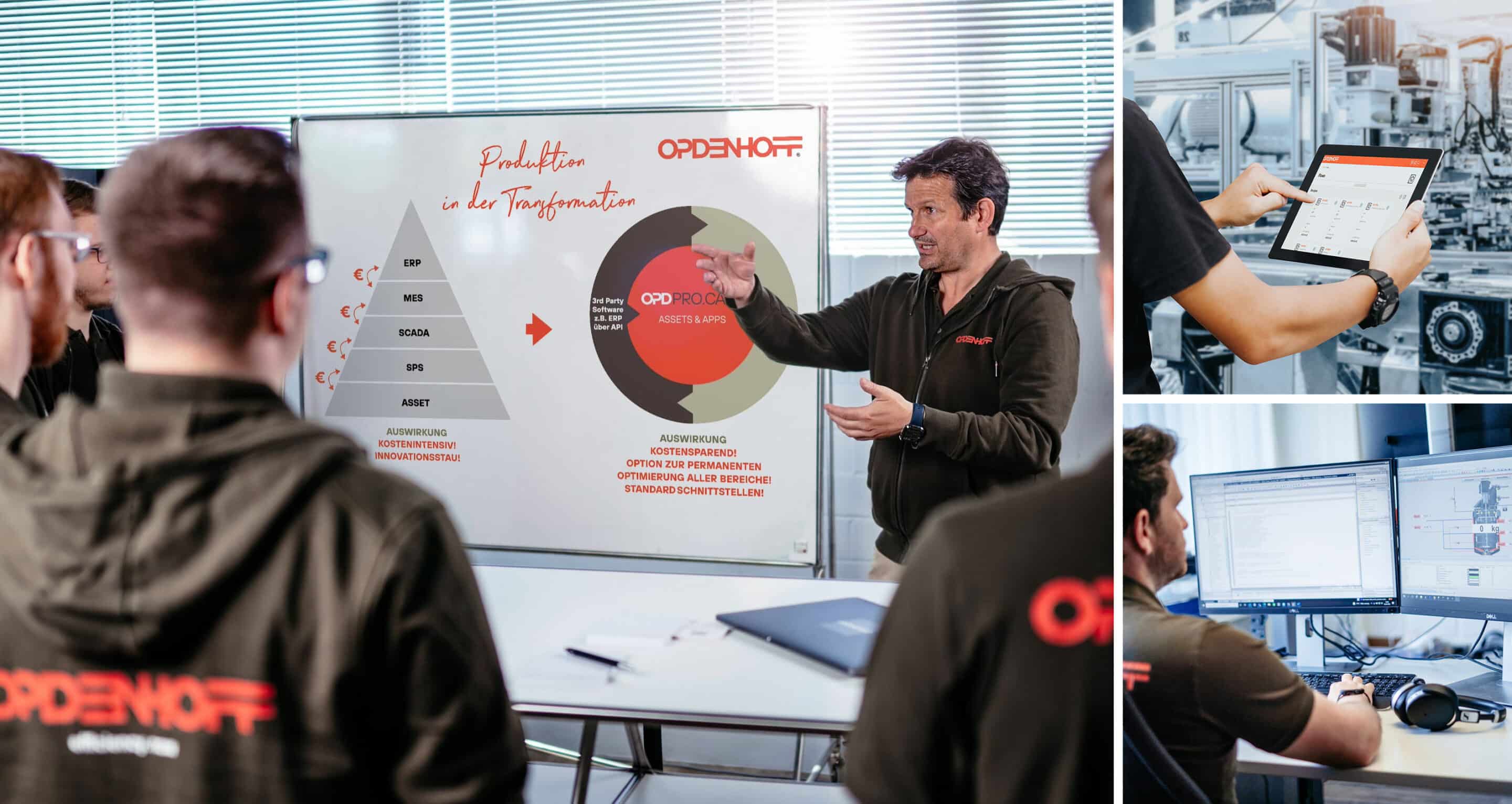
Ready for the first concrete AI use case?
You have a lot of data, but still too little actionable knowledge?
Would you like to detect process deviations faster, secure production knowledge, or connect AI directly to your digital value stream?
Then let's not start with a big AI project.
We'll start with a specific question from your process.
To the date overview
 German
  English
  Polish
  Ukrainian
  French
  Portuguese
  Russian
  Spanish
  Italian
  Hindi
Hindi  Dutch
Dutch  Hungarian