
Weighing and Dosing in the Process Industry: Why Every Gram Matters
Introduction
Scales are much more than measuring devices in the process industry.
You decide on quality, recipe adherence, traceability, scrap, rework, and customer satisfaction.
Especially in raw material handling for powders, granules, liquids, carbon black, silica, additives, or small quantities, the scale is a central point in the value stream.
If errors occur here, they directly affect the product.
Why scales are critical in bulk material handling
In many production processes, the setpoint is not the only deciding factor.
Also crucial are:
- Tolerances
- Gross electricity
- Fine stream
- After-run
- Shutdown point
- Bulk density
- Material behavior
- Dosiergeschwindigkeit
- Filtering
- Downtime
- Taring
- Calibration
- Charge allocation
Only when mechanics, control systems, software, and process knowledge are aligned can a scale work precisely, especially with difficult raw materials.
Understanding Tolerances, Lead, and Shutdown Point
A key point in dosing is the shutdown point.
This is the moment the dosing element is closed, even though material is still flowing.
This residue is never purely theoretical. It depends on the mechanics, the raw material, the dosing speed, and the condition of the equipment.
If the cutoff point is chosen incorrectly, overdosing or underdosing will occur.
Therefore, it requires experience.
SIWAREX Experience since the Beginning
OPDENHOFF has been working with SIWAREX weighing technology for many years.
This experience is particularly valuable because weighing technology in practice is not just about hardware.
A good dosage arises from the interplay of:
- Load cells
- SIWAREX Module
- PLC programming
- Dossier organizer
- Material behavior
- Plant mechanic
- Recipe
- Operating Concept
- Evaluation and Logging
Standard solutions are often not sufficient here.
Those who only install one module don't have good dosing yet.
.
Scales, PLCs, and SCADA as a common unit
In modern plants, the scale can no longer be considered in isolation.
She's not just a measuring instrument that records a weight. She's an important part of the entire value stream.
Because in practice, the scale decides on quality, productivity, traceability, and process reliability in many areas. It is often located precisely where raw materials are introduced into the process, partial quantities are dosed, formulations are implemented, or batches are evaluated.
Therefore, the scale today must know more than just a weight value.
She needs to know which order the weight belongs to.
She needs to know which recipe is currently being used.
She needs to know which raw material is being used.
She must know the batch.
It must be connected to the respective asset.
And it must be considered in the context of quality, tolerances, releases, and process parameters.
Only then does a single measurement become truly usable information.
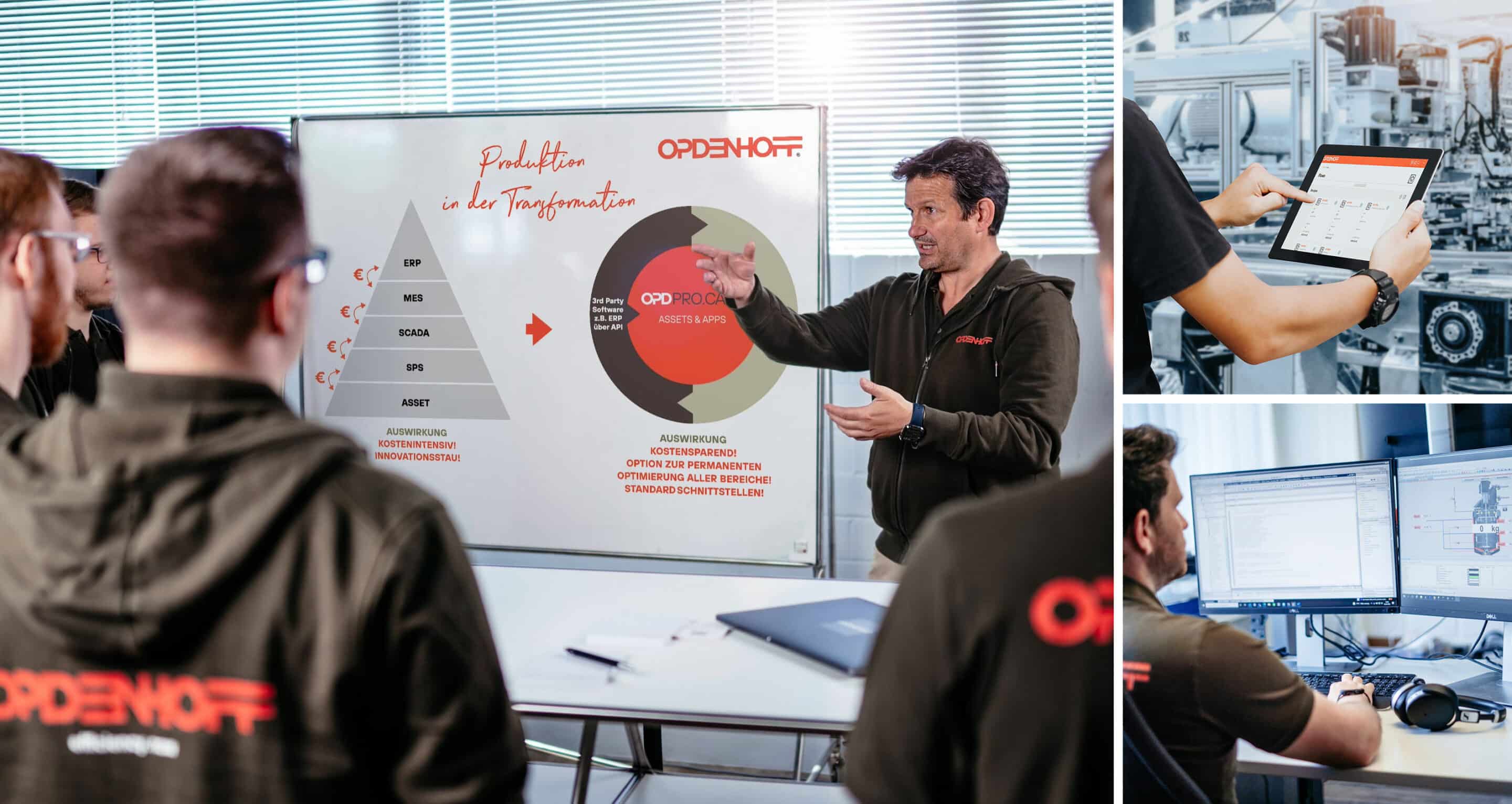
The scale is integrated into a continuous digital logic via PLCs, SCADA, API interfaces, and OPDPRO.CARE. The weight value is not just displayed but processed in the correct context.
This is how it can be checked whether the correct raw material was used, whether the quantity matches the recipe, whether tolerances were observed, and whether the data can later be clearly assigned to an order, a batch, or a finished product.
This makes the scale part of the digital twin in the value stream.
This is particularly important when production data is not only to be documented but also actively used. For example, for better quality, less waste, reliable traceability, automatic logs, predictive analysis, or improved production control.
OPDPRO.CARE connects this information along the entire material flow. A transparent database is created from the raw material through dosing and weighing to the finished product.
This transforms the scale from an individual measuring point into an active component of the value stream.
That's precisely where the difference between classic automation and true digitalization lies.
.
Secure recipe management and batch records digitally
A modern recipe management system must not rely on manual entries.
Ideally, an order comes digitally from the ERP or MES.
The recipe is released for transmission.
The PLC controls the dosage.
The scale provides target and actual values.
The batch record documents the process.
OPDPROCARE connects this data with the digital twin.
This is how a truth is created, from raw material to finished product.
Fewer manual inputs, fewer errors
Many mistakes do not arise because people work badly.
They arise because systems force them to make manual entries.
Manual tolerances, manual recipe changes, or manual material selection can lead to quality risks in everyday operations.
Therefore, a goal of modern IT OT systems is:
As few manual inputs as possible. As much process security as necessary.
.
OPDPRO.CARE connects scales with the value stream
With OPDPRO CARE will the scale become part of the digital value stream.
Then it's understandable:
- which scale has dispensed
- which raw material was used
- what tolerance applied
- which order was active
- which batch was created
- whether there were deviations
- which assets were involved
This creates transparency, quality, and responsibility.
.
Conclusion: Weighing is quality assurance in the process
Scales are key to quality.
Those who modernize raw material handling, dosing, and weighing not only improve measurement values. They improve responsibility in the process.
OPDENHOFF connects weighing technology, PLC, SCADA, API interfaces and OPDPRO.CARE into a solution that truly understands the material flow.
Do you want to improve your scales, dosing, or recipe management?
We will analyze together where accuracy, transparency, and process security can be improved.
 German
  English
  Polish
  Ukrainian
  French
  Portuguese
  Russian
  Spanish
  Italian
  Hindi
Hindi  Dutch
Dutch  Hungarian