
Modernizing SPS Controls: TIA Portal, S7 1500, and IT OT Integration
Introduction
The PLC is the heart of many production facilities.
It controls drives, valves, scales, conveyor technology, mixers, dispensers, safety signals, and process sequences.
However, many PLC systems have grown over the years. Programs have been expanded, adapted, and repaired. Often, the clear structure that modern production requires is now missing.
Why old PLC systems become a risk
Many facilities are still running, but the risks are increasing:
- Spare parts are becoming scarce
- Knowledge is lost with employees.
- Programs are difficult to understand
- Interfaces are missing
- Recipe data is entered manually
- Protocols are incomplete
- New requirements are difficult to integrate
- IT security is getting harder
An SPS modernization is therefore more than a technical exchange.
It's an opportunity to reorder the process.
S7 1500 and TIA Portal as a modern foundation
Modern control concepts can be cleanly implemented with Siemens S7 1500 and TIA Portal.
The hardware isn't the only important thing.
The structure is crucial:
- clear building blocks
- understandable data models
- Clean recipe management
- stable communication
- secure operating concepts
- Diagnostic capability
- Interface capability
- Reusability
Especially in raw material handling and mixing processes, the PLC must understand the material flow.
Structured PLC Programs for Improved Maintainability
A modern PLC control system must be designed to remain understandable in the long term.
This includes:
- clear naming concepts
- modular building blocks
- clean diagnosis
- Reusable functions
- clear interfaces
- Structured data blocks
- clear separation of process, operation, and communication
This reduces errors and makes future expansions easier.
Recipe Management in the Value Stream
A modern recipe management system shouldn't just consist of tables.
She needs to know:
- which order is being produced
- which raw materials are needed
- Which scales are involved
- what tolerances apply
- What order will be followed
- what permissions are required
- which batches must be logged
The PLC controls the time-critical part. OPDPROCARE and higher-level systems establish the connection to the value stream.
.
SIWAREX, Weighing and Dosing in PLC
Scales and dosing are particularly sensitive functions in the PLC.
This isn't just about inputs and outputs. It's about process quality.
The PLC must precisely interact with SIWAREX, dosing units, raw material data, recipe values, and tolerances.
A stable and traceable dosage can only be achieved when all information is cleanly linked.
API interfaces are changing the role of control.
Previously, the PLC was often a closed world.
Today it needs to be connected to other systems:
- ERP
- MES
- SCADA
- OPDPROCARE
- Databases
- Edge Systems
- Digital twins
This isn't about cramming everything into the PLC.
It's about solving the right problem in the right place.
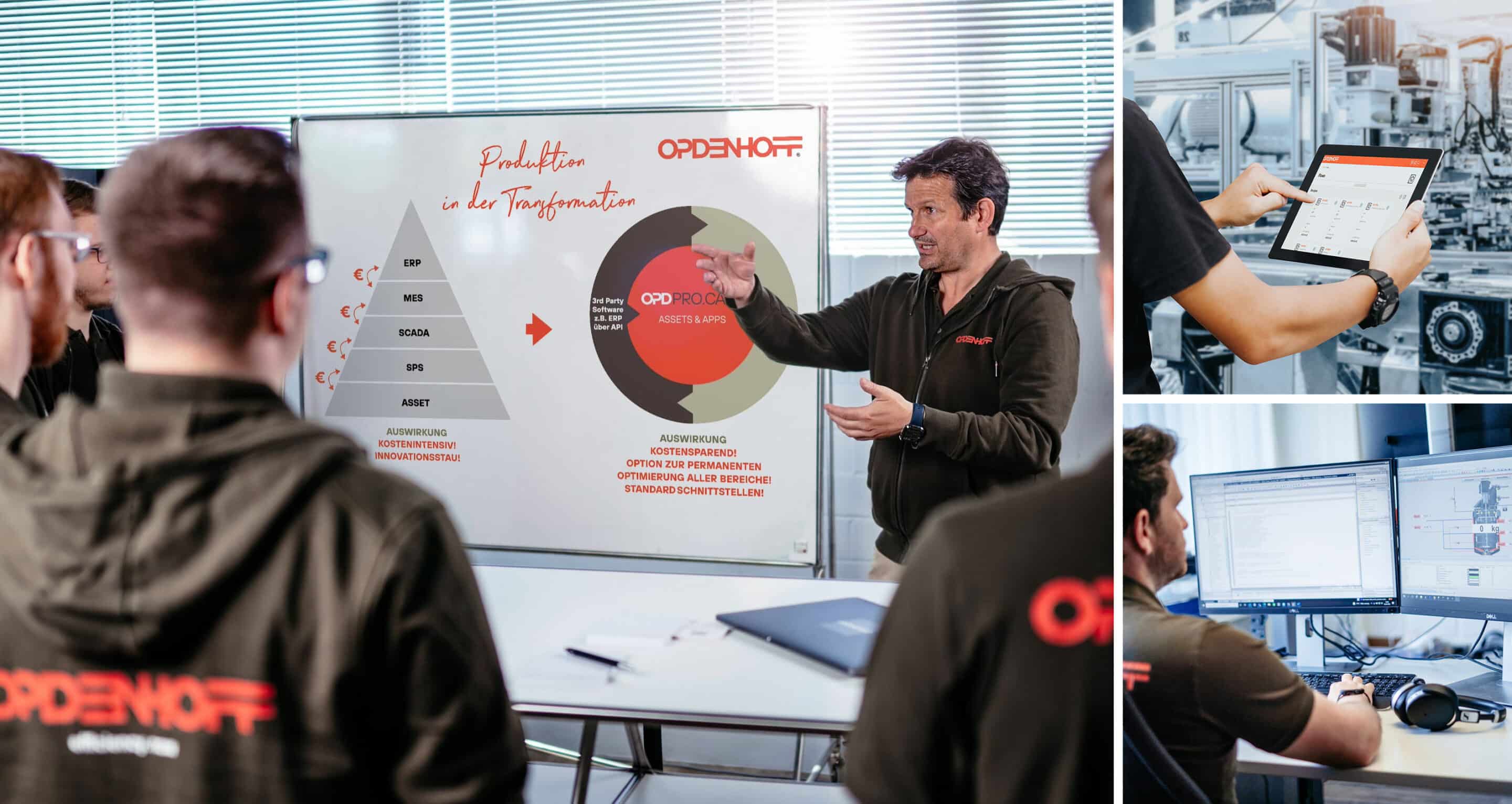
The PLC remains responsible for real-time, sequence, and safety. The connection to the order, raw material, asset, and final product is established via API interfaces and OPDPROCARE.
The OPDENHOFF Approach: Connecting Control, Process, and Data
OPDENHOFF comes from practice.
We are familiar with control cabinet construction, PLC programming, commissioning, raw material handling, scales, SCADA, and software.
This allows us to not only program PLC systems but also integrate them into the overall process.
Our goal is:
A control system that is not only functional, but also understandable, maintainable, secure, and connectable.
Conclusion: The PLC remains the heart of the system, but not alone
Modernizing the SPS is the right time to rethink the IT OT structure of a plant.
Those who switch from old systems to modern PLC technology today should not just replace the code. They should make the value stream digitally connectable.
OPDENHOFF supports this, from the control cabinet to the interface.
Are you planning a PLC modernization?
We are examining how control systems, SCADA, scales, APIs, and OPDPROCARE can logically work together.
 German
  English
  Polish
  Ukrainian
  French
  Portuguese
  Russian
  Spanish
  Italian
  Hindi
Hindi  Dutch
Dutch  Hungarian