
SCADA Systems in the Process Industry: From Visualization to Process Transparency
Introduction
SCADA systems are the central interface for operators, shift supervisors, maintenance, and production in many plants.
They display states, alarms, curves, recipe data, and process values.
But modern SCADA systems must do more than just nice system pictures.
You must help understand processes.
Why classic visualization is no longer sufficient
Many SCADA systems show what is happening.
But they don't always explain why it happens.
Typical vulnerabilities include:
- too many alarms
- unclear operating diagrams
- missing priorities
- No connection to order and batch
- No clear raw material assignment
- Weak logging
- No connection to the ERP
- Data without context
The result is data, but not yet a decision-making tool.
SCADA must guide the operator through the process.
A good SCADA system makes work easier.
It not only shows values, but guides people through the process.
For example:
- What assignment is running
- Which formulation is active
- which raw materials are needed
- Which scale is currently dispensing
- What tolerance applies?
- where a fault occurred
- what action makes sense
- which batch is affected
This makes SCADA a tool for quality and accountability.
Alarms, Setpoints, and Process Data: Correctly Categorized
An alarm alone doesn't create a solution.
The important question is:
What does this alarm mean for the value stream?
Does the malfunction affect a batch?
Is a raw material affected?
Does a product need to be blocked?
Is the scale out of tolerance?
Is there a connection to maintenance or energy consumption?
By connecting SCADA and OPDPROCARE, such questions become easier to answer.
.
SCADA and PLC as the operational level of production
SCADA and PLCs together form the operational level of production.
The PLC controls the process.
SCADA makes the process operable.
OPDPROCARE establishes the connection in the value stream.
These three levels must work together seamlessly so that production, quality, and maintenance can make better decisions.
.
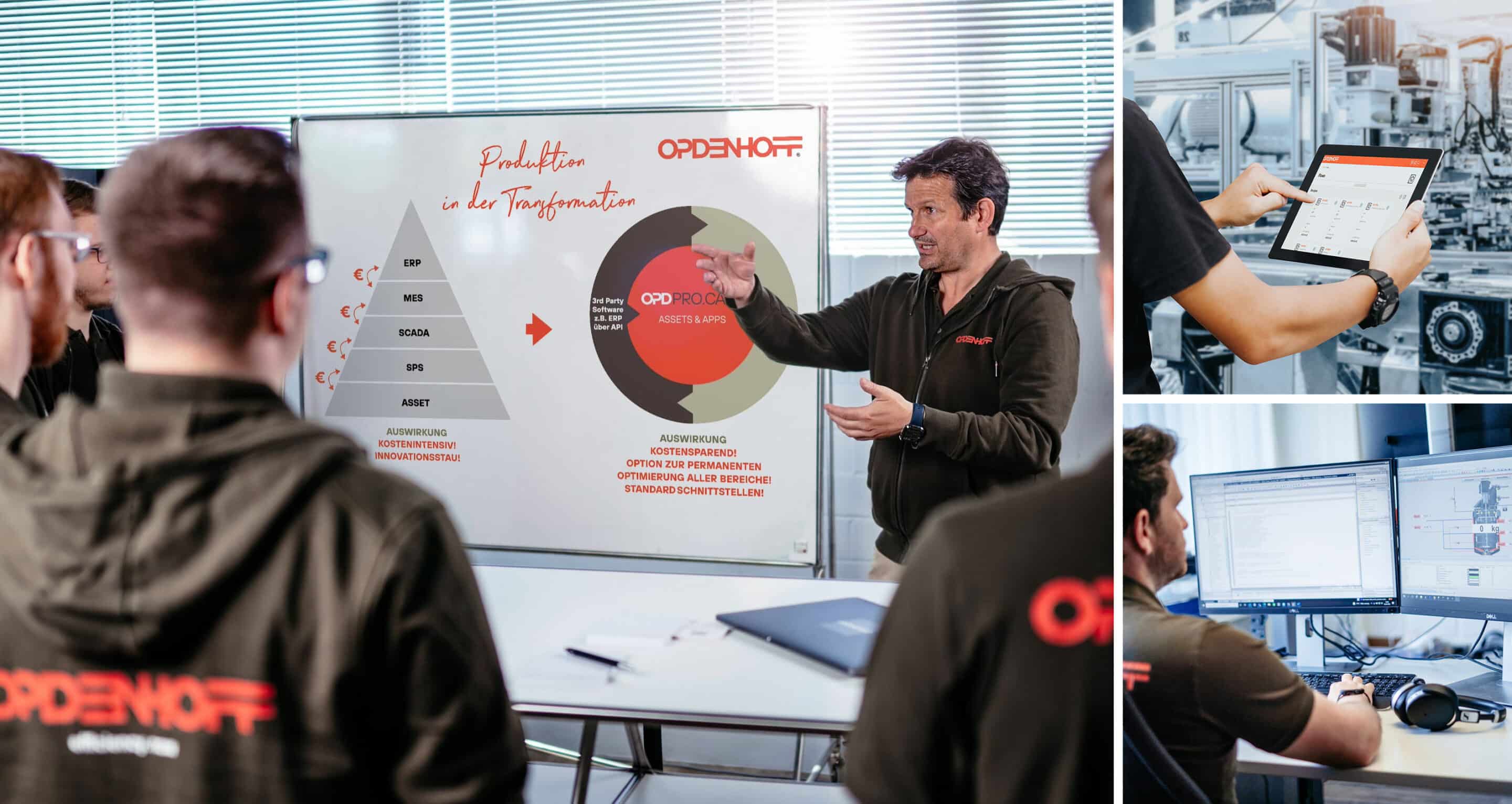
OPDPRO.CARE expands SCADA to a digital value stream
OPDPRO.CARE expands SCADA into a digital value stream because it doesn't stop at purely visualizing the plant. Classic SCADA systems are strong at making machine statuses, process values, alarms, and operating screens visible. They show very well what is currently happening in the plant.
OPDPRO.CARE goes a step further.
The solution connects this technical information with the business and process context. It shows which order is running, which recipe is being used, which raw material was used, which batch is affected, which asset was involved, what quality data was generated, what maintenance information is relevant, and how much energy was consumed in the process.
This creates an understandable connection from individual data points.
This exact connection is crucial when companies want to actively use production data, not just monitor it. Because only when data is linked can decisions emerge from it. Why was there a deviation? Which system was involved? Which raw material was used? Was the recipe correct? Was there a maintenance history? How does energy consumption affect the batch?
OPDPRO.CARE makes these questions answerable.
The digital twin of the value stream creates a common truth about production, material flow, and equipment status. People in production, quality, maintenance, engineering, and management work with this same data basis. This reduces coordination efforts, prevents information loss, and creates transparency from raw material to finished product.
This way, SCADA is not replaced, but meaningfully expanded.
SCADA remains the strong layer for operation and plant visualization. OPDPRO.CARE complements this layer with structure, context, traceability, and intelligence. This creates an open IT/OT bridge that utilizes existing automation and makes the value stream digitally manageable.
From Alarm to Cause: Understanding Data in Context
Data only becomes valuable when it is in context.
A process value alone is just a value.
An alarm alone is just an event.
A batch alone is just a number.
Only when this information is connected does a true understanding of the process emerge.
.
The OPDENHOFF Approach: Visualization with Process Knowledge
OPDENHOFF does not develop SCADA systems in isolation.
We consider:
- Operation
- Process Logic
- PLC
- Scales
- Recipe management
- Charge Records
- Interfaces
- Digital twins
- later evaluations
This creates a visualization that matches the real process.
.
Conclusion: SCADA becomes the bridge between humans, machines, and data
SCADA systems remain important. But they must evolve.
From pure display to process transparency.
From the fault list to the cause.
From Plant Layout to Value Stream Understanding.
OPDENHOFF connects SCADA with PLC, API interfaces and OPDPROCARE.
Do you want to modernize your SCADA system?
We show how visualization, process data, and digital twins can work together meaningfully.
 German
  English
  Polish
  Ukrainian
  French
  Portuguese
  Russian
  Spanish
  Italian
  Hindi
Hindi  Dutch
Dutch  Hungarian