
Machinery Directive and Retrofit | What Operators Should Consider
Introduction
The new EU Machinery Regulation will come. Starting in 2027, new requirements will apply to machines, systems, software, cybersecurity, documentation, and CE marking.
For many operators, this will not only be a legal change. It will be an operational challenge in ongoing operations.
This is why we want to discuss it with you early on at OPDENHOFF. Personally, honestly, and from practical experience.
Why operators should act now
For over 55 years, OPDENHOFF has been supporting productions, machines, and plants in the process industry. I myself have been working in automation, switchgear construction, retrofitting, engineering, and digitalization for over 33 years.
During this time, I have experienced many technological changes. Every day, I see the dedication of people in production to ensure that quality, delivery reliability, safety, and competitiveness are maintained.
However, with the new EU Machinery Regulation, the requirements for many existing machines and systems are increasing.
The technology itself is often not the biggest problem.
We'll find technical solutions together.
The real challenge lies in the increasing complexity surrounding documentation, proof of compliance, software, cybersecurity, responsibilities, interfaces, and CE requirements.
Retrofit not starting until 2027
If you want to continue using machines or systems long-term, now is the right time to prepare retrofit projects.
Not before 2027.
The longer the wait, the greater the increase in effort, dependencies, and bureaucratic requirements. At the same time, it becomes more difficult to cleanly consolidate available resources, documentation, suppliers, software versions, and technical responsibilities.
In the end, that costs time, money, and valuable energy.
In contrast, an early planned retrofit creates transparency, security, and freedom of decision.
What changes for operators
The new Machinery Regulation does not only apply to new machines. Modifications, modernizations, software changes, safety-relevant adjustments, and digital enhancements can also have implications for assessment, documentation, and responsibility.
Therefore, it becomes more important for operators:
Machines and systems must be technically understood.
Documentation must be traceable.
Software versions, interfaces, and changes must remain transparent.
Cybersecurity must be considered.
CE requirements must be assessed early on.
Responsibilities must be clear between the operator, machine manufacturer, integrator, and service partner.
This is precisely where the greatest risks often arise in practice.
OPDENHOFF supports operators in retrofitting with Siemens S7
1500 and TIA Portal allow modern control concepts to be implemented cleanly.
OPDENHOFF connects classic engineering with automation, control panel construction, PLC, SCADA, Digitalization and digital twin.
We aren't just looking at the individual machine, but the entire context within the value stream.
From the existing system, Control, sensor technology, software, documentation, and security to later operational use.
Our goal is not to build unnecessary complexity.
Our goal is to make existing machines and systems future-proof, traceable, and economically usable.
Our approach
We analyze existing machines, systems, and processes.
We are reviewing technical documentation, controls, Interfaces and existing software versions.
We assess risks, Need for modernization and possible CE effects.
We develop practical retrofit concepts.
We integrate open technologies without unnecessary dependencies.
We create transparency through Digital twins, structured data and clear responsibilities.
And we ensure that new added value is created from old machines and systems.
Digital twins create clarity
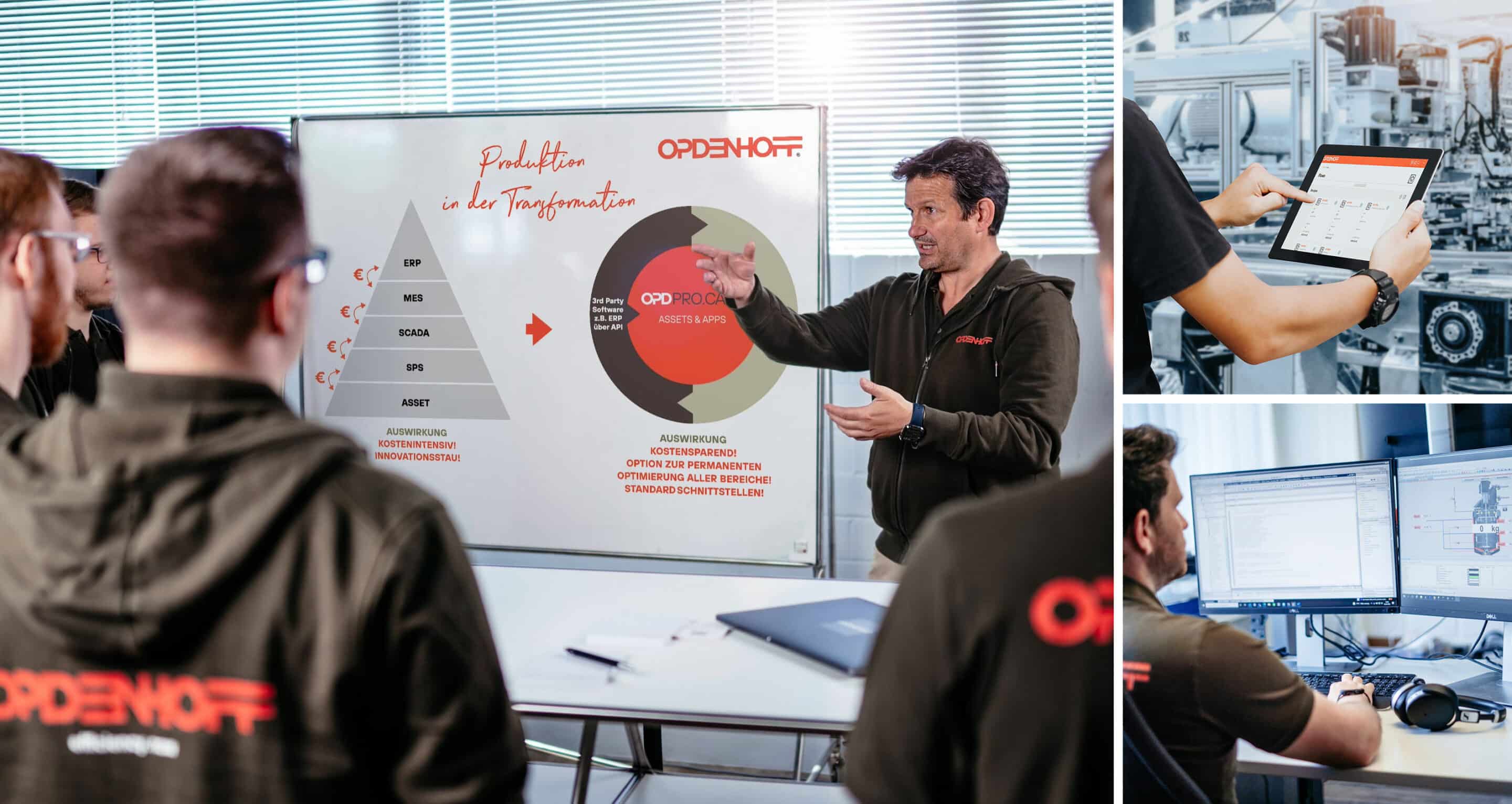
With OPDPRO.CARE, we create digital connections along the value stream.
Machines, plants, raw materials, processes, states, maintenance, energy, documentation, and operating knowledge are not considered in isolation, but managed in a common digital context.
This leads to a better understanding of real-world operations.
This not only helps with transparency, service, and maintenance.
It also helps to better document technical changes, identify risks early on, and make decisions that are easy to understand.
Responsibility instead of fear
The new Machinery Regulation should not be a cause for concern.
It is an occasion to take responsibility.
For secure facilities.
For strong teams.
For competitive productions.
For industrial strength in Germany and Europe.
Acting early gains you time, clarity, and room to maneuver.
Our Personal Appeal
Take care of your machines, processes, and documentation early on.
Not out of fear of new regulations.
But rather out of a sense of responsibility for your future, your employees, and your production.
Combining your expertise with our know-how—gained from 55 years at OPDENHOFF, over 33 years of hands-on experience, and modern AI solutions—we are able to implement retrofit projects in a way that is clear, cost-effective, and future-proof.
Even budget managers can be persuaded if technology delivers clear added value.
Conclusion: Together we are future-proofing existing plants
Do you want to know if your machines and plants are prepared for upcoming requirements?
Then get in touch with us.
Together, we’ll assess your current situation, identify any risks, and determine which retrofit measures make sense.
It's not complicated.
Not theoretically.
But practical, honest, and with a focus on what truly matters in business.
OPDENHOFF
We care about our customers.
Would you like to modernize your existing plant?
We are examining together how Retrofit, PLCs, SCADA, scales, and IT OT interfaces can be logically integrated.
 German
  English
  Polish
  Ukrainian
  French
  Portuguese
  Russian
  Spanish
  Italian
  Hindi
Hindi  Dutch
Dutch  Hungarian