
Retrofit in the process industry: Modernizing existing S5 and S7 control systems without vendor lock-in
Introduction
Many plants in the plastics industry, rubber industry, chemical industry, or feed industry have a common problem:
The mechanics are still valuable, but control, visualization, interfaces, and documentation are no longer future-proof.
This is exactly where Retrofit comes in.
A good retrofit not only extends the service life of a plant. It creates the foundation for better quality, more transparency, higher availability, and a modern IT/OT architecture.
Why Retrofit Is Becoming More Important Today
Many operators face similar challenges:
- older PLC controls like S5 or S7 300
- difficult spare parts supply
- grown programs without a clear structure
- old control panels
- Missing batch records
- Manual prescription entries
- No clean connection to ERP or MES
- Missing data for quality, energy, and maintenance
- Increasing demands for security and documentation
The problem isn't just technology. The problem is responsibility.
When processes are no longer transparent, it becomes difficult to ensure quality, traceability, and efficiency.
Typical weaknesses of old systems
Many existing plants have grown over the years. They have been expanded, repaired, adapted, and often optimized under time pressure.
This creates typical vulnerabilities:
- unclear program structures
- missing standards
- Different operating concepts
- No central recipe management
- weak diagnostic capabilities
- manual data transfer
- No consistent batch logic
- unclear responsibilities in case of disruptions
A retrofit should not simply adopt these vulnerabilities but consciously improve them.
Retrofitting in the Blending Room: From Raw Material to Finished Batch
Retrofitting is particularly challenging in the mixing room.
For stamp mills, internal mixers, rolling mills, dosing, scales, silos, small quantities, and oils, simply replacing the PLC is not enough.
The entire material flow must be understood:
From raw material, through silo, scale, conveying technology, and mixer, to the finished batch.
Many questions are crucial in this regard:
- What raw materials are processed?
- What scales are involved?
- What tolerances apply?
- How is the caster calculated?
- Where is the shutdown point?
- Which formulations must be maintained?
- How are batches documented?
- What interfaces does the customer need?
SPS Modernization with TIA Portal and S7-1500
Modern control concepts can be cleanly implemented with Siemens S7 1500 and TIA Portal.
What's important isn't just the hardware. The structure is crucial:
- clear building blocks
- understandable data models
- Clean recipe management
- stable communication
- secure operating concepts
- Diagnostic capability
- Interface capability
- Reusability
A modern PLC must not only run. It must be maintainable, understandable, and connectable.
SCADA, Scales, and Recipe Management: Seamless Integration
A retrofit only becomes truly powerful when PLCs, SCADA, scales, and recipe management work together seamlessly.
That means:
The scale doesn't just know one weight.
The PLC knows more than one sequence.
The SCADA system does not just show one image.
Recipe management is not just a table.
Everything must be brought into a common context.
OPDPRO.CARE as a digital twin for the value stream
With OPDPROCARE, a retrofit can be further expanded.
Then not only a new control system is created, but a digital twin for the value stream.
OPDPROCARE connects:
- Assets
- Raw materials
- Orders
- Recipes
- Charge-on
- Scales
- Process data
- Quality data
- Maintenance
- Energy
- Interfaces
This not only monitors the process. It makes it understandable and controllable.
The OPDENHOFF Approach: One-Stop Retrofitting
OPDENHOFF combines retrofit with process knowledge.
We are not just modernizing hardware. We are connecting PLCs, SCADA, scales, API interfaces, and OPDPROCARE into a seamless solution.
Typical retrofit modules are:
- Analysis of the existing plant
- Inspection of mechanics, hydraulics, drives, and load cells
- Switch cabinet construction
- Transition to Modern PLC Systems
- Engineering in TIA Portal
- new visualization with HMI or SCADA
- Recipe management
- Charge Records
- Interfaces to ERP, MES, or OPDPROCARE
- Integration into the digital twin
- Commissioning and Training
.
Conclusion: Retrofit existing systems and make them digitally connectable
Retrofitting is an opportunity to rethink existing systems.
Not in the sense of buying everything new. But in the sense of:
Maintain existing values, modernize technology, and make the process digitally connected.
OPDENHOFF supports operators and plant manufacturers in implementing retrofits without vendor lock-in.
From experience. From a single source. From the control cabinet to the digital twin.
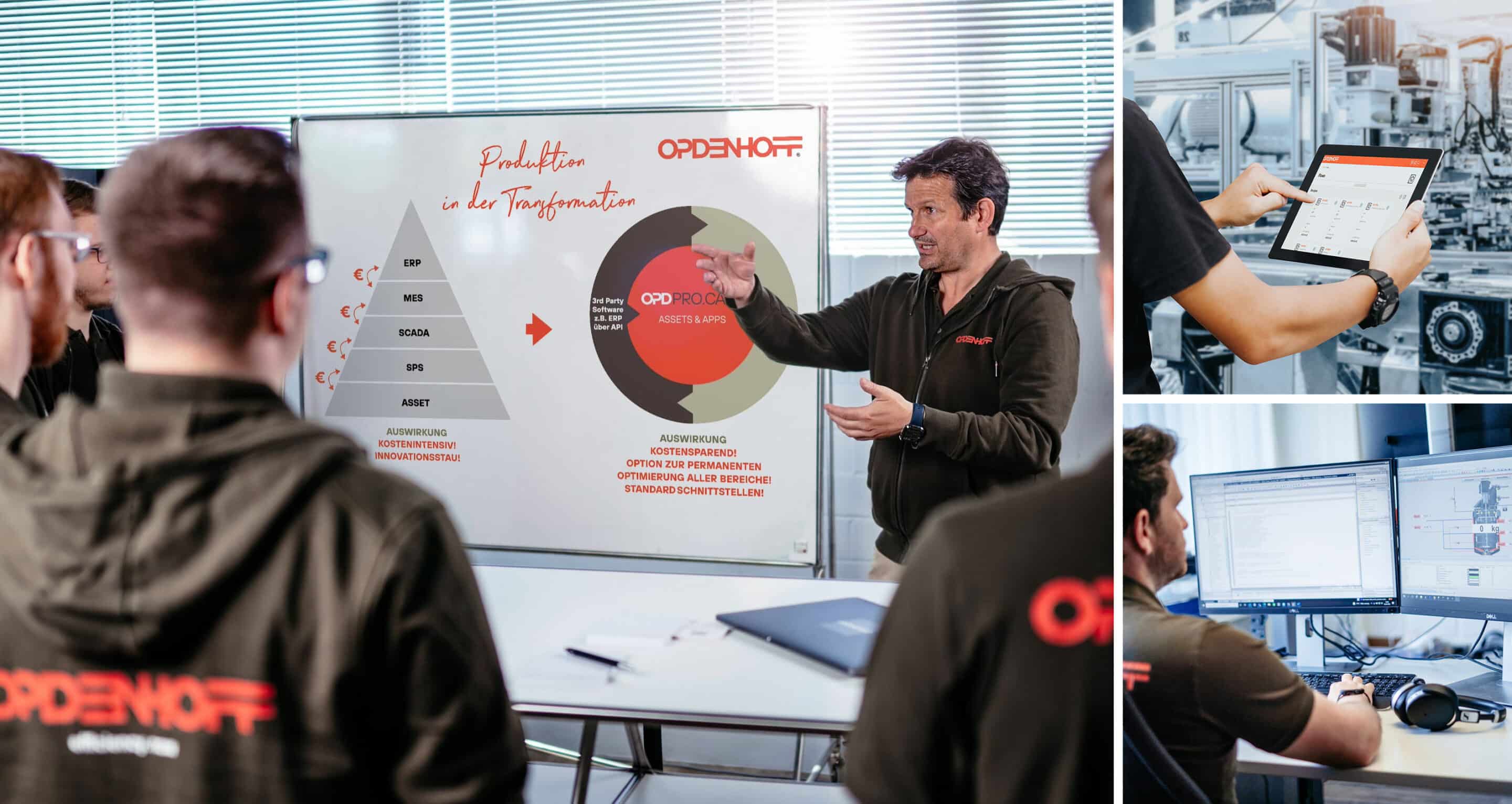
Would you like to modernize your existing plant?
We are examining together how Retrofit, PLCs, SCADA, scales, and IT OT interfaces can be logically integrated.
 German
  English
  Polish
  Ukrainian
  French
  Portuguese
  Russian
  Spanish
  Italian
  Hindi
Hindi  Dutch
Dutch  Hungarian